


Every article gives you the theory. This one gives you the scars — and the honest advice engineers wish they had before choosing.
Let me tell you about a conversation I had with a lead engineer three years ago. Their team had just finished a six-month migration — tearing apart a perfectly working Rails monolith into 27 microservices. When I asked how it went, he paused for a second and said, “We now have 27 problems instead of one.”
That line stuck with me. Not because microservices are bad — they’re not. But because the decision was made for the wrong reasons, at the wrong time, by people who had read all the right articles and still walked straight into the trap.
This piece isn’t going to be another feature comparison table with green checkmarks and red X’s. You’ve seen those. Instead, I want to talk about the things that rarely make it into blog posts — the tradeoffs that only reveal themselves at 2 AM when your distributed system is falling apart in ways your architecture diagram never predicted.
The internet told you Netflix uses microservices. It forgot to mention that Netflix also has thousands of engineers and an entire platform team just to manage them.
First, Let’s Be Honest About What These Terms Mean
When most engineers say “monolith,” they imagine a giant ball of spaghetti code that nobody understands, ships once a quarter, and crashes if you look at it wrong. And when they say “microservices,” they imagine clean, independent little boxes — each doing one thing beautifully.
Both mental images are wrong.
A monolith is simply a single deployable unit. It can be beautifully structured, well-tested, and ship to production ten times a day. The codebase at Stack Overflow — which handles billions of requests monthly — ran on a monolith for years. Same with Shopify. Same with Basecamp.
Microservices, meanwhile, aren’t automatically clean. In fact, the worst architecture I’ve personally seen wasn’t a tangled monolith. It was a microservices system where teams had drawn service boundaries in exactly the wrong places, creating what the industry now calls a “distributed monolith” — all the complexity of microservices, none of the benefits.
So before you choose an architecture, ask yourself: what problem am I actually trying to solve?
The Real Reason Teams Choose Microservices (And It’s Not Technical)
Here’s something nobody says out loud: most microservices migrations aren’t driven by technical necessity. They’re driven by organizational pressure.
A CTO reads about Netflix. The team is growing fast and different squads keep stepping on each other’s code. Deployments are becoming a coordinated nightmare that needs a Slack channel and a prayer. Somebody mentions “microservices” in a meeting and everyone nods like it’s obviously the answer.
And sometimes — genuinely — it is the answer. But the honest reason isn’t usually “our services need independent scalability.” It’s “we need teams to move faster without blocking each other.” That’s a Conway’s Law problem, not a deployment problem. And sometimes the right solution is better module boundaries inside the monolith, not a full decomposition.
⚠️ Watch out for this pattern
If the main reason your team wants microservices is “it’s what modern companies do” — that’s not a reason. That’s a trend. Architecture decisions should be driven by your specific constraints, not by what’s in a conference talk.
What the Blog Posts Don’t Tell You About Microservices
1. Distributed Systems Are Hard. Like, Really Hard.
When you split a monolith into services, every function call that used to be in-process becomes a network call. And networks fail. They time out. They’re slow. They return partial results. Suddenly, you’re not just writing business logic — you’re handling partial failures, retry storms, circuit breakers, and eventual consistency.
In a monolith, you wrap something in a database transaction and it either commits or it doesn’t. In microservices, coordinating a single “order placed” event across three services — inventory, payment, notification — requires either a saga pattern, an event bus, or a lot of very careful thinking about what happens when step 2 succeeds and step 3 fails.
# Monolith: Simple, atomic, understandable
def place_order(user, cart):
    with db.transaction():
        order = create_order(user, cart)
        deduct_inventory(cart.items)
        charge_payment(user, cart.total)
        send_confirmation_email(user, order)
    return order

# All or nothing. Clean.


# Microservices: Now you’re managing distributed state

# What happens if payment succeeds but inventory already sold out?
# What if the email service is down? Do you retry? Rollback?

# Welcome to the saga pattern.
# You’ll need compensation logic.
This isn’t unsolvable — millions of systems handle it every day. But it’s a layer of complexity your team has to be genuinely ready to own. If you’re a team of five and this is your first production system, the operational overhead can kill velocity faster than any shared codebase ever would.
2. Observability Goes From Nice-to-Have to Survival
In a monolith, when something breaks, you look at one log file. Maybe add a few print statements. In a microservices architecture, a single user request can touch 8 different services. When it fails, figuring out where it failed requires distributed tracing — tools like Jaeger, Zipkin, or Datadog APM stitching together a trace ID across every service hop.
Without good observability, debugging microservices feels like being handed a bag of puzzle pieces from five different boxes and asked to find the one missing piece.
📌 Real talk
Budget for observability before you migrate. If you’re not already running structured logging, distributed tracing, and alerting, fix that first — in your monolith. These skills transfer directly and make the eventual migration much safer.
3. Local Development Becomes a Nightmare
This one surprises new microservices teams every time. Running the full system locally — which you need to do to test anything end-to-end — now means spinning up 10+ services. Some teams use Docker Compose. Others use Kubernetes locally with tools like Minikube or Tilt. Many end up in a half-baked setup where half the services are mocked and half are real, and nobody is quite sure what that means for test reliability.
I’ve seen engineers spend half their day just getting a working local environment before they can write a single line of code. That’s a real cost, and it compounds across every new hire who joins the team.
What the Blog Posts Don’t Tell You About Monoliths
1. A Well-Structured Monolith Can Scale Further Than You Think
Most apps never reach the scale that actually requires microservices. A single well-optimized Postgres instance can handle tens of thousands of requests per second. A Ruby or Go monolith behind a load balancer with read replicas will serve most startups for years — often to profitability and beyond.
The real scaling bottleneck for most teams is engineer throughput, not server throughput. And here, a clean monolith often wins: one codebase to understand, one CI/CD pipeline, one place to look when something breaks.
2. The “Big Ball of Mud” Is a People Problem, Not an Architecture Problem
If your monolith is a mess, migrating to microservices won’t fix it. It’ll just distribute the mess across the network. Teams that can’t maintain clean boundaries in a single codebase will draw those same messy boundaries between services — and now those dependencies are invisible contracts enforced only by HTTP calls that nobody documents.
Discipline, code reviews, domain-driven design, and clear module ownership — these fix a messy codebase. Microservices are not a substitute for engineering culture.
The Honest Comparison
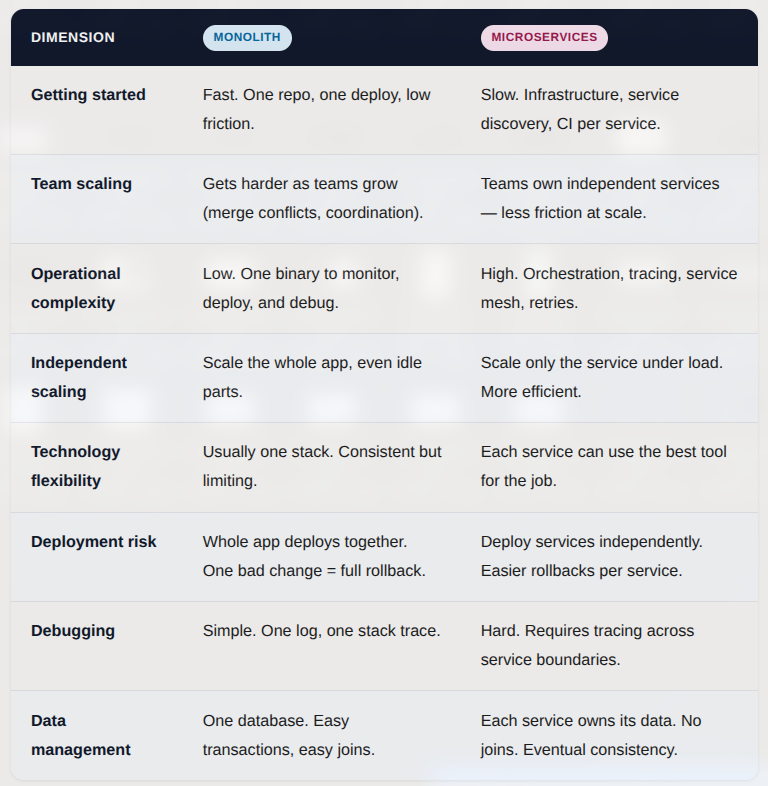
So When Should You Actually Choose Each One?

The Middle Path Nobody Talks About
Here’s what I actually recommend to most teams: start with a modular monolith.
A modular monolith is a single deployable unit where the internal code is organized into clearly bounded modules — almost like services, but without the network overhead. Each module owns its domain logic and its data access layer. Cross-module calls go through defined interfaces, not direct database queries.
This gives you most of the organizational benefits of microservices — clear ownership, independent team velocity, enforced boundaries — without the operational complexity. And when the day genuinely comes that a particular module needs to be extracted into its own service, the boundary is already clean. You’re not carving up spaghetti. You’re lifting out a well-defined component.
It’s the architecture equivalent of “make it work, then make it right, then make it fast.” Start simple. Extract when you have a real, specific reason — not because you saw a conference talk about it.
✅ A rule of thumb that has served me well
If you can’t clearly articulate what problem microservices would solve for you right now — and point to the specific pain point in your current system — you’re probably not ready for them. And that’s completely okay.
Final Thoughts
The microservices vs. monolith debate is, at its core, a conversation about tradeoffs. Not about what’s modern or what Netflix does or what gets the most GitHub stars. It’s about matching your architecture to your team’s size, your product’s maturity, your operational capabilities, and your actual scaling needs.
Every system starts simple and grows complex. The art isn’t in picking the “right” architecture upfront — it’s in understanding your current constraints clearly enough to make a decision you can evolve from, not get trapped in.
Start boring. Ship fast. Let real pain drive real change. Your future self — the one who doesn’t get paged at 2 AM because a service mesh config is misbehaving — will thank you.
The best architecture isn’t the one on the whiteboard. It’s the one your team can actually build, operate, and understand at 3 AM when everything is on fire.
Buy Me Coffee 😊
https://www.patreon.com/CodeWithPushpa25/gift
Did this resonate with you?
If you’ve lived through a painful monolith-to-microservices migration — or made the decision to not migrate and it was the right call — share your story. The best architecture lessons live in the trenches, not the textbooks.